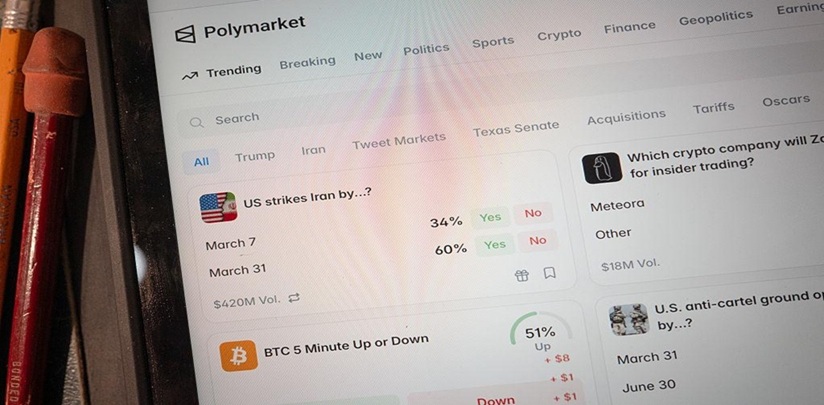
Delays Appear Concentrated Around Polymarket US Payment and Review Systems
A cluster of Polymarket US users is reporting withdrawal delays lasting a week or longer, with some customers saying pending payouts were eventually returned to their balances only for their entire accounts to be placed on hold.
The reports, which remain unverified user accounts rather than confirmed platform-wide problems, point toward possible bottlenecks involving payment processing, identity verification or manual account review rather than evidence that Polymarket lacks the money to honor withdrawals.
One Reddit user said several withdrawal requests had remained pending for between seven and 11 days before the funds suddenly reappeared in the user’s Polymarket balance. The account was then placed on hold, preventing further withdrawals or other activity.
Other users responding to the same Sept. 7 thread described similar experiences. One said an eight-day withdrawal had encountered the same problem. Another, whose withdrawal had also remained unresolved for more than a week, said repeated emails eventually resulted in the case being escalated to Polymarket’s payout department, after which the withdrawal was processed.
A separate Sept. 5 discussion contained additional complaints about withdrawal availability on the U.S. app. One user said they had been unable to withdraw approximately $6,000 for 96 days before finally resolving the issue with support, while another described waiting more than two weeks after depositing before attempting to withdraw winnings. These claims have not been independently verified.
The reports are significant because Polymarket’s own technical documentation describes materially shorter payment-processing times.
Polymarket US uses Aeropay for ACH bank transfers. Its developer documentation states that both ACH deposits and withdrawals normally require one to three business days. The payment system allows Polymarket to initiate withdrawals directly to a user’s linked bank account and track those transactions through Aeropay.
Polymarket also supports card and Apple Pay transactions through Checkout.com. Its payments documentation lists bank transfers through Aeropay as taking one to three business days, while card and Apple Pay funding are described as instant.
That makes complaints involving withdrawals sitting unresolved for seven, eight or 11 days notably longer than the documented ACH processing period.
The distinction between Polymarket’s U.S. product and its international website is also important.
Polymarket.com and Polymarket US are separate platforms. The international service uses blockchain-based accounts and withdrawals, while U.S. residents use the Polymarket US app, which has its own accounts, customer support and payment infrastructure. Polymarket directs U.S. customers to a separate support address and explicitly states that the two sets of accounts are not connected.
The recent complaints involving bank accounts, debit cards and Apple Pay therefore appear to involve Polymarket US rather than withdrawals of USDC from the international platform.
Polymarket US also has a more conventional regulated financial infrastructure behind it. Polymarket Clearing, formally QC Clearing LLC, is registered with the Commodity Futures Trading Commission as a derivatives clearing organization and is authorized to clear fully collateralized futures, options and swaps.
Its documentation shows that withdrawals do not necessarily move directly from a customer request to an external payment processor. A withdrawal can first be reviewed at the clearing level, and requests may be denied if removing the cash would leave insufficient buying power to support existing margin obligations or open positions.
There are also signs that payment-related complaints predate the current September cluster.
In July, one user reported a $1,000 deposit that had been debited from their bank but was not credited to Polymarket for days. Other users in the thread described similar cases. One participant later claimed that a backlog had developed after bank deposits were temporarily turned off, while the original complainant eventually reported receiving the funds.
Other users have described deposits remaining unavailable for withdrawal even after their banks appeared to show that the underlying payment had cleared. A June discussion included users saying that Polymarket sometimes provided trading buying power immediately but continued restricting withdrawals until the underlying deposit finished clearing internally.
Manual escalation is another recurring feature.
In a July support discussion, one user said an account had remained locked for weeks despite submitting requested identification documents. Another participant advised contacting Polymarket employees directly through LinkedIn, saying that doing so had resulted in a case being fixed the same day. A different user later reported contacting Polymarket again through LinkedIn and subsequently regaining withdrawal access.
Other community accounts describe users contacting support through email, Discord and direct outreach before withdrawal restrictions were lifted. In one case described by a user, the actual transfer arrived within roughly 30 minutes once withdrawal access was restored.
None of those cases establish why the accounts were restricted, whether the underlying reviews involved fraud controls, identity verification, payment reversals or other compliance checks.
They do, however, raise a more specific question than whether Polymarket can pay customers: why do some withdrawals remain stuck for days until human intervention appears to move the case forward?
The Real Risk May Be Operations, Not Solvency
The worst way to read these complaints is to jump immediately from “withdrawal delayed” to “Polymarket is insolvent.”
There is currently no evidence in the cases reviewed that supports that conclusion.
In fact, several of the complaints point in the opposite direction. Users often say the money ultimately returns to their Polymarket account or reaches their bank after support intervenes. That looks much more like money becoming trapped somewhere in a payment, compliance or account-review workflow than money simply not existing.
That distinction matters.
A regulated prediction-market app connected to banks, debit cards and Apple Pay has to deal with risks that do not exist in a simple crypto-wallet withdrawal. ACH payments can be reversed. Card payments can be disputed. Identity information may need additional verification. Fraud systems can flag unusual funding patterns. The clearinghouse also needs to make sure a withdrawal does not leave a trader undercollateralized.
Holding a withdrawal under those circumstances is not inherently suspicious.
The problem is what happens next.
If an automated risk system flags an account but the only way to clear that flag is for a human employee to review it, then customer-service capacity effectively becomes part of the payments infrastructure.
That appears to be the interesting pattern in the complaints.
A withdrawal spends eight days pending. Emails go unanswered. The transaction is escalated internally. Suddenly it proceeds.
Another account remains restricted until somebody contacts an employee through LinkedIn. Then the case moves.
If those anecdotes accurately reflect the process, the delay is not necessarily the bank taking eight days to move money. It may be Polymarket taking eight days to reach the decision that allows the bank transfer to begin.
Polymarket’s own Aeropay documentation makes that distinction particularly important. The external ACH rail is supposed to take roughly one to three business days. A withdrawal that sits inside Polymarket for a week before being released could therefore produce a much longer customer experience even when Aeropay itself operates normally.
That becomes a scaling problem.
Prediction markets are competing increasingly on the same attributes as sportsbooks and trading apps: markets, pricing, liquidity and increasingly the mundane question of how easily customers can get their money back.
A user may tolerate additional identity checks on a $10,000 withdrawal. What is harder to tolerate is not knowing whether a transaction is waiting for a bank, a compliance review, a payment processor or an unanswered support ticket.
The most revealing detail in these reports is therefore not that some withdrawals took 11 days.
It is that several users describe the delay disappearing shortly after someone finally touched the case.
If Polymarket can verify that pattern, the fix may have less to do with liquidity and much more to do with building enough automated review capacity, escalation tooling and human payments support to match the growth of its U.S. business.

Shane Neagle is a financial markets analyst and digital assets journalist specializing in cryptocurrencies, memecoins, prediction markets, and blockchain-based financial systems. His work focuses on market structure, incentive design, liquidity dynamics, and how speculative behavior emerges across decentralized platforms.
He closely covers emerging crypto narratives, including memecoin ecosystems, on-chain activity, and the role of prediction markets in pricing political, economic, and technological outcomes. His analysis examines how capital flows, trader psychology, and platform design interact to create rapid market cycles across Web3 environments.
Alongside digital assets, Shane follows broader fintech and online trading developments, particularly where traditional financial infrastructure intersects with blockchain technology. His research-driven approach emphasizes understanding why markets behave the way they do, rather than short-term price movements, helping readers navigate fast-evolving crypto and speculative markets with clearer context.