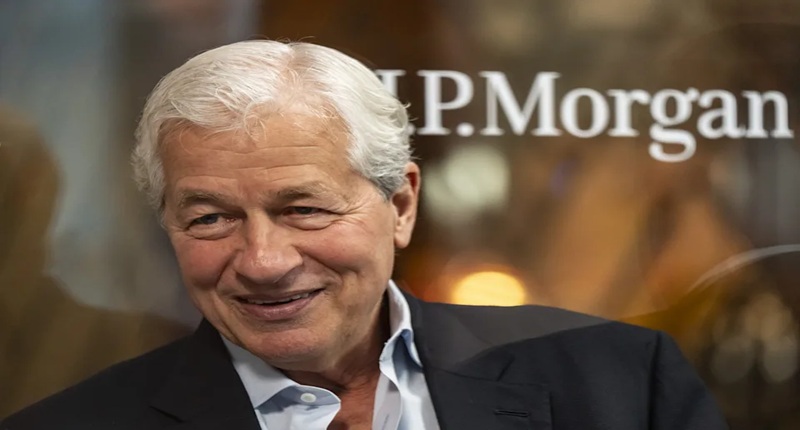
Jamie Dimon learned to value companies before he was old enough to drive.
The JPMorgan Chase chairman and chief executive has revealed how his father, a Wall Street stockbroker, used investment simulation exercises to teach him how businesses work, why stocks trade at different prices and what separates a plausible investment idea from a guess.
Speaking on The Master Investor Podcast with Wilfred Frost, Dimon said his father would give him a familiar industry, such as restaurants, and ask him to study its history, read annual reports and decide what he would be willing to pay for a company’s shares.
“He would give me an industry you might know something about, like a restaurant,” Dimon said. “And say, ‘Okay, look at this. Look at the history. Read the annual report. Study the industry if you want. What would you pay for the stock?’”
The exercise sounds simple. It was not.
Dimon described the process as “brutally hard,” because reaching a price required more than finding a successful company. He had to understand how the business generated revenue, what could damage its earnings, how much growth investors had already priced into the shares and why one company deserved a higher valuation than another.
“Then you learn the ‘why,’” Dimon said.
That early training became the foundation of a career that would eventually put Dimon in charge of the largest US bank by assets and make him one of Wall Street’s longest-serving chief executives.
Dimon, now 70, has led JPMorgan Chase as CEO since 2006. The bank generated $185.6 billion in revenue and $57 billion in net income during 2025, extending a run of record results and strengthening its position across consumer banking, investment banking, trading, payments and asset management.
Yet the discipline behind that scale began at home, with annual reports and hypothetical investments.
A Stockbroker Father and One Interested Son
Dimon’s father, Theodore Dimon, encouraged all three of his sons to understand markets and investing.
Only Jamie became deeply interested.
While his brothers showed less enthusiasm for stocks, Dimon gravitated toward the challenge of evaluating companies and making decisions without knowing whether he would be right.
By high school, his reading habits were already unusual. Dimon said he spent time reading material on psychology, economics and accounting, including the investment work of Benjamin Graham and David Dodd.
“I read Graham and Dodd in high school — I was a nerd,” Dimon said. “I read all of Freud’s books. I always would be taking this stuff in.”
Graham and Dodd’s approach focused on understanding a company’s underlying economics rather than following market excitement. Their work became central to value investing and later influenced investors including Warren Buffett.
For Dimon, however, the lesson was broader than buying statistically cheap shares.
Studying accounting taught him how businesses recorded results. Economics helped him think about industries and cycles. Psychology offered clues about how people behave when incentives, fear and ambition collide.
Those subjects would eventually become difficult to separate.
A bank CEO must understand financial statements, but also depositors, borrowers, traders, regulators, employees and politicians. Numbers matter. So do the people creating them.
Dimon bought his first stock in 1970 at age 14 with help from his father. The investment marked the beginning of a relationship with markets that continued through college, business school and a series of increasingly senior Wall Street positions.
From Tufts to Sandy Weill’s Office
Dimon graduated from Tufts University before earning an MBA from Harvard Business School.
After Harvard, he joined American Express in 1982 as an assistant to Sanford “Sandy” Weill, beginning a professional relationship that shaped much of his early career.
The position did not carry the authority normally associated with an ambitious Harvard MBA. Dimon was not immediately running a division or leading deals. He was observing, analysing and trying to make himself useful.
“My first goal was to learn something and not say anything until I could add some value,” Dimon said in a 1984 Fortune profile, when he was 28.
That approach resembled the investment exercises his father had given him.
First, understand the business.
Then speak.
The apprenticeship under Weill became Dimon’s practical education in how financial companies operate. When Weill left American Express to take control of consumer lender Commercial Credit in 1986, Dimon went with him.
At 30, Dimon became Commercial Credit’s chief financial officer.
The company became the starting point for a series of acquisitions that eventually produced Travelers Group and later Citigroup. Dimon worked closely with Weill through much of that expansion, developing experience in acquisitions, capital allocation, cost control and the difficult process of combining financial businesses.
The relationship did not last.
Dimon left Citigroup in 1998 following a power struggle after the Travelers-Citicorp merger. The split could have ended his rise toward the top of Wall Street.
Instead, it reset his career.
Bank One Created the Route to JPMorgan
Dimon became CEO of Bank One in 2000, taking over a large institution struggling with weak performance and operational problems.
The assignment allowed him to apply the management principles he had developed over the previous two decades. Bank One cut costs, strengthened controls, improved its technology and rebuilt profitability.
JPMorgan Chase agreed to merge with Bank One in 2004.
Dimon became president and chief operating officer of the combined bank before taking over as CEO at the end of 2005. He became chairman one year later.
His timing mattered.
Within two years, the global financial system entered its most severe crisis since the Great Depression. Bear Stearns collapsed. Lehman Brothers failed. Washington Mutual was seized by regulators. Citigroup and Bank of America required extraordinary government support.
JPMorgan was not untouched by the crisis, but it remained strong enough to acquire Bear Stearns and most of Washington Mutual’s banking operations.
Dimon emerged as one of the crisis era’s most prominent banking executives.
Nearly two decades later, he remains in the job.
That makes him an outlier on Wall Street, where leadership changes, strategic failures, scandals and board pressure frequently shorten CEO tenures. Most of the executives who ran major financial institutions before or during the 2008 crisis have long since departed.
Dimon stayed.
JPMorgan’s Scale Reflects Years of Reinvestment
Under Dimon, JPMorgan has grown into a financial institution spanning retail branches, credit cards, commercial lending, investment banking, markets, payments, private banking and asset management.
The bank generated record revenue of $185.6 billion in 2025, up from $180.6 billion in 2024. Net income reached $57 billion, while return on tangible common equity was 20%.
Its position is not the result of one transformational product or a single market bet.
JPMorgan has repeatedly reinvested in technology, risk management, branches, staff and regulatory systems, even when those expenses reduced short-term profit. Dimon has argued that companies weaken themselves when they manage only for the next quarter.
That does not mean JPMorgan has avoided mistakes.
The bank has faced large legal settlements, trading losses, regulatory penalties and internal control failures during Dimon’s tenure. The 2012 “London Whale” trading loss became one of the most visible examples, costing the bank billions and exposing weaknesses in risk oversight.
Dimon has frequently acknowledged such failures while defending the broader culture of accountability and investment that helped the bank recover.
His estimated personal fortune has grown to approximately $3.2 billion, making him one of the rare professional bank executives to become a billionaire without founding the institution he runs.
But when asked whether he always expected to build JPMorgan into a company approaching a $1 trillion market valuation, Dimon answered simply.
“No.”
Discipline Before Size
Dimon said deliberately chasing the title of the world’s largest bank would be the wrong objective.
“I think you get in trouble if you say, ‘I want to be the biggest bank in the world,’” he said.
Instead, he compared business leadership with the careers of NFL quarterbacks Tom Brady and Peyton Manning. Neither depended solely on being the fastest runner or possessing the strongest arm, Dimon said. Their success came through preparation, judgment and repeatedly executing the basics.
It is a philosophy Dimon has expressed in other settings.
He has said leaders should bring full effort to every meeting and decision, even though not every attempt will succeed.
“You can’t hit a home run every time you’re at the bat,” Dimon said during the 2025 Fortune Most Powerful Women Summit. “You keep working, stay humble, and work hard.”
The principle connects directly to the exercises his father gave him decades earlier.
Read the annual report.
Understand the industry.
Choose a price.
Then explain why.
Dimon’s Real Edge Was Learning to Explain the Price, Not Predict It
The childhood story is charming.
Father gives son an annual report. Son studies restaurants. Son becomes Wall Street king.
Neat.
A little too neat, actually.
Jamie Dimon did not build JPMorgan because he read Graham and Dodd in high school. Plenty of people have read the same books. Some of them still blow up their portfolios chasing biotech tips and zero-day options.
The useful part is the question his father forced him to answer.
What would you pay?
Not whether the company was good.
Not whether the restaurant was busy.
Not whether the chief executive sounded impressive.
What would you pay?
That is where investing gets ugly.
A brilliant company can be a terrible stock at the wrong price. A boring business can become a great investment when expectations fall low enough. Growth means nothing unless you know what the market already assumes.
I think that distinction explains more about Dimon than the usual biography does.
He was trained early to separate admiration from valuation.
Most people never learn that.
“Why” Is the Hard Part
Anybody can pick a number.
The stock is worth $50.
Bitcoin is heading to $200,000.
This bank should trade at 15 times earnings.
That startup is a $10 billion company.
Fine.
Why?
That second question kills most investment pitches.
If you cannot explain the revenue engine, margins, capital requirements, competitive threats, industry cycle and downside case, the valuation is decoration.
Dimon’s father apparently did not let him hide behind decoration.
Read the history.
Study the industry.
Read the annual report.
Choose the price.
Brutal is the correct word.
Because the deeper you go, the less certain you feel.
A restaurant looks easy until you start thinking about rent, labour, food inflation, table turnover, franchise economics, debt and how quickly customers disappear when a trend dies.
A bank is worse.
A bank’s assets are somebody else’s promises to repay. Its liabilities can leave. Its reported profit can look fantastic right before credit losses hit. Confidence matters so much that a liquidity problem can become a solvency problem while management is still explaining the previous quarter.
Dimon spent his life inside that machine.
The childhood game fit.
Reading Freud Was Probably More Useful Than It Sounds
The Freud line is easy to treat as a quirky detail.
Teenage Jamie Dimon reading psychology while everyone else is doing something normal. Very on-brand.
But finance is psychology wearing a spreadsheet.
Bank runs are psychological.
Credit bubbles are psychological.
Executive rivalries are psychological.
Acquisition fever is psychological.
Market panic is psychological.
Accounting tells you what happened.
Psychology tells you why people kept doing it after the warning signs appeared.
I would argue that Dimon’s feel for institutional behaviour became at least as important as his technical knowledge. JPMorgan’s strength during crises has depended partly on numbers — capital, liquidity, reserves — but also on understanding how customers, regulators and markets behave under pressure.
When everybody feels safe, risk gets underpriced.
When everybody panics, solid assets get dumped.
We have seen that cycle forever.
Dimon has too.
Sandy Weill Was the Second Simulation Game
The childhood exercises happened on paper.
The Sandy Weill years happened with real companies, jobs and capital on the line.
Commercial Credit. Travelers. Citigroup.
Acquisitions stacked on acquisitions.
Dimon learned how businesses are priced, bought, cut apart and stitched together. He saw what happens when ambition works. Then he saw what happens when power gets crowded at the top.
His exit from Citigroup matters because it broke the clean upward career story.
He got pushed out.
That could have been it.
Wall Street loves rising executives until they stop rising. Once somebody loses an internal fight, the market starts treating them like damaged inventory.
Dimon came back through Bank One.
That is probably the more important chapter than Harvard, American Express or the teenage stock purchase. Bank One gave him a struggling operating business. No simulation. No famous mentor taking the blame.
Fix it or wear it.
He fixed it.
JPMorgan’s “Fortress” Is Not Just a Balance Sheet
People hear Dimon talk about a fortress balance sheet and think it means hoarding capital.
That is part of it.
But a real fortress is built before the attack.
Technology that works.
Risk systems that catch strange positions.
Managers willing to bring bad news upstairs.
Enough liquidity to avoid desperate funding.
Enough earnings power to absorb losses.
Enough credibility that depositors do not sprint for the door.
Boring stuff.
Until it saves the company.
The 2008 crisis turned Dimon into a symbol of cautious banking, although JPMorgan still took losses and needed government support mechanisms available to the wider system. The myth can get overcooked.
Still, the bank was capable of acting when competitors were collapsing.
That was not luck alone.
JPMorgan had capacity.
There is a huge difference.
The London Whale Proved the System Was Not Magic
Then came the London Whale.
Billions lost through a trading strategy buried inside an operation supposedly designed to hedge risk.
That was not a small embarrassment. It punched directly at JPMorgan’s claim to superior control.
And this is where I think the Dimon story becomes more useful.
The best-run company can still do something stupid.
Smart managers can miss obvious risks.
Large profits can hide bad incentives.
A respected institution can start believing its own press.
The lesson is not that Dimon never failed.
It is that JPMorgan survived its failures without becoming defined by them.
Investors should pay attention to that.
Perfection is fake. Recovery capacity is real.
Chasing Size Would Have Broken the Bank
Dimon’s rejection of “I want to be the biggest bank in the world” sounds like standard humility from somebody who already runs the biggest US bank.
Convenient.
But the underlying point is right.
Size is an outcome. It is a terrible operating target.
Banks that chase size usually loosen something.
Underwriting.
Pricing.
Controls.
Acquisition discipline.
Balance-sheet risk.
They start lending because competitors are lending. They buy companies because the market rewards expansion. They hold assets with tiny yields because management wants volume.
Then the cycle turns.
Gone.
JPMorgan became huge by making plenty of aggressive moves, but Dimon’s public framework has consistently focused on earning power, capital, systems and client relationships rather than raw asset growth.
That framework sounds less exciting.
It also ages better.
The Athlete Comparison Works — Up to a Point
Tom Brady and Peyton Manning did not dominate because of one obvious physical advantage.
Preparation mattered. Repetition mattered. Reading defenses mattered.
Fair comparison.
But banking is not football.
When a quarterback throws an interception, millions of depositors are not exposed. A bad fourth quarter does not freeze credit markets. Taxpayers do not need emergency programmes because the offensive line missed a block.
The stakes are different.
Still, Dimon’s point about consistency lands.
Most corporate disasters are not caused by leaders forgetting some secret genius move. They happen because institutions stop doing basic things properly.
They ignore the ugly report.
They reward the wrong metric.
They silence the difficult employee.
They chase the hot competitor.
They assume yesterday’s liquidity will still be there tomorrow.
The basics look unimpressive right up until everyone else forgets them.
Effort Is Not the Whole Formula
Dimon likes the language of hard work.
Give 100% every day.
Stay humble.
Keep working.
I get it.
But hard work is one of those business lessons that becomes useless when stripped from judgment. People can work insanely hard on bad strategies. Entire companies can grind themselves into the floor.
Effort needs direction.
The stronger lesson from Dimon’s childhood is not “work hard.”
It is: make the decision explainable.
Why this company?
Why this price?
Why now?
What would prove you wrong?
What happens when the cycle turns?
That process forces discipline into the room.
It also exposes bullshit fast.
The $185.6 Billion Result Is the Receipt
JPMorgan generated $185.6 billion in revenue in 2025.
That number is absurdly large.
But revenue alone is not the proof. Banks can manufacture growth by taking more risk, stretching the balance sheet or buying earnings.
The more meaningful figures are the $57 billion in net income and 20% return on tangible common equity, achieved while the bank continued spending heavily on technology, controls and expansion.
That is operating leverage at monster scale.
I would not pretend every dollar came from Dimon’s childhood lessons. Interest rates, regulation, acquisitions, market structure and JPMorgan’s enormous funding base all played a role.
Still, capital allocation culture starts somewhere.
Dimon learned early that money should have a price.
Later, he applied that idea to businesses, acquisitions, loans, risk and the bank’s own capital.
The Market Will Find Out What Survives Him
There is one obvious problem with the Jamie Dimon success story.
Jamie Dimon eventually leaves.
JPMorgan has spent years preparing possible successors, rotating senior executives and trying to prove that the institution is deeper than one person.
Markets are not fully convinced.
I’m not either.
A company can have excellent managers and still depend on one leader’s credibility, especially during a crisis. Dimon has decades of relationships with regulators, investors, government officials and corporate clients. You cannot hand that network to a successor in a folder.
The real test of his management philosophy will arrive after he is gone.
Does the bank keep questioning its assumptions?
Does bad news still travel upward?
Does it keep investing through difficult periods?
Does the next CEO understand the difference between being the biggest and being built to survive?
That is the final valuation exercise.
Not what Jamie Dimon would pay for JPMorgan today.
What the market should pay when he is no longer the person explaining why.

Shane Neagle is a financial markets analyst and digital assets journalist specializing in cryptocurrencies, memecoins, prediction markets, and blockchain-based financial systems. His work focuses on market structure, incentive design, liquidity dynamics, and how speculative behavior emerges across decentralized platforms.
He closely covers emerging crypto narratives, including memecoin ecosystems, on-chain activity, and the role of prediction markets in pricing political, economic, and technological outcomes. His analysis examines how capital flows, trader psychology, and platform design interact to create rapid market cycles across Web3 environments.
Alongside digital assets, Shane follows broader fintech and online trading developments, particularly where traditional financial infrastructure intersects with blockchain technology. His research-driven approach emphasizes understanding why markets behave the way they do, rather than short-term price movements, helping readers navigate fast-evolving crypto and speculative markets with clearer context.