X Adds Banking Features to Its Social Platform
Elon Musk’s X has begun rolling out X Money to paid subscribers in the United States, moving the financial service beyond its earlier invitation-only testing and taking another step toward Musk’s long-promised “everything app.”
The broader rollout began July 27 and initially covers select X Premium and Premium+ subscribers aged 18 or older. Rather than operating as a separate banking application, X Money is built directly into the existing X platform, allowing users to hold funds, send payments and manage a debit card without leaving the social network.
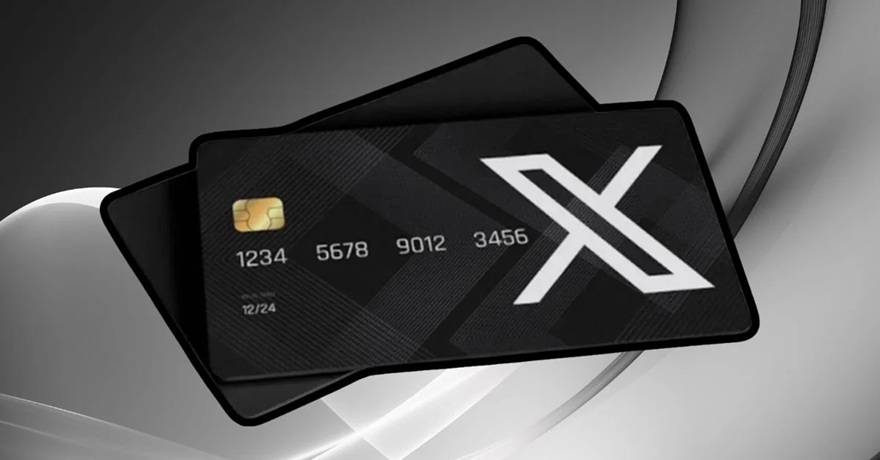
Users receive a virtual X Visa debit card automatically after opening an account. The card can be added to Apple Wallet and used through Apple Pay, while customers can also order a physical metal version and choose whether their X username appears on it.
X says the card can be used anywhere Visa is accepted, carries no foreign transaction fees and offers free ATM withdrawals worldwide. ATM operators may initially charge a fee, but X says eligible charges will be reimbursed within three calendar days. Cardholders can also earn 3% cash back on qualifying purchases, although some transaction categories are excluded.
X Money also introduces instant peer-to-peer transfers between users. The company advertises the transfers as free and without limits, positioning the service against established payment applications such as Venmo, Cash App and Zelle.
Beyond transfers, users can arrange direct deposits, receive eligible paychecks up to two days early, pay bills, send wires and request mailed checks through the X app.
One of the service’s main attractions is an interest rate of up to 6% APY.
Premium+ subscribers are eligible for the full 6% rate, while regular Premium subscribers may qualify after meeting X Money’s direct-deposit requirements. The rate was accurate as of July 27 but is variable and can change.
X Premium currently starts at $8 per month or $84 per year through the company’s website in the United States. Premium+ costs $40 per month or $395 per year, meaning access to X Money’s highest rate is tied to a wider paid subscription rather than being offered as a stand-alone savings product.
Despite offering bank-like features, X Money is not itself a bank.
Customer accounts are held at Cross River Bank, a regulated New Jersey financial institution that provides the banking infrastructure, deposit accounts and access to payment networks behind the service. X Payments LLC operates the user-facing product inside X.
Cross River described the arrangement as the first time a U.S. social media platform has directly embedded interest-bearing, Federal Deposit Insurance Corp.-insured accounts, a Visa debit card and peer-to-peer payments into its platform.
Funds held directly at Cross River are eligible for the standard FDIC insurance limit of up to $250,000, subject to the usual conditions. X Money automatically enrolls deposits in a cash sweep program that distributes funds among participating banks, potentially increasing aggregate pass-through FDIC coverage to $10 million.
X Payments is not FDIC insured, and the protection applies only if one of the participating insured banks fails. Customers must also meet the requirements for pass-through insurance coverage.
The rollout remains limited. X’s website says the product is available only to select U.S. users, rather than every paid subscriber immediately. X Payments has secured money-transmitter licenses in 41 states and Washington, D.C., but the service is not yet available in New York or Massachusetts.
The launch revives an idea Musk has pursued for more than two decades.
He founded the original X.com as an online financial-services company in 1999. The business later merged with Confinity and developed into PayPal. After acquiring Twitter in 2022, Musk renamed the social network X and began outlining plans to combine communication, content, commerce and financial services within one platform.
X Money gives that plan its first substantial consumer-finance product. At launch, however, the service remains focused on conventional dollar accounts and payments rather than cryptocurrency or stablecoin transfers.
The immediate challenge will be persuading users to treat an account inside a social media application as a place for their paychecks and savings, not merely as another way to send small payments between friends.
The Real Test Is Whether Users Trust X With Their Money
X Money’s individual features are not especially new. High-yield accounts, debit-card rewards, early direct deposit and instant transfers are already widely available from banks and fintech applications.
What makes the launch important is where those features are being placed.
X already has the social connections, conversations and creator communities through which payments could naturally move. A user would not necessarily need another person’s bank details or phone number. The payment relationship could begin with an existing X account.
That gives X a distribution advantage that most new fintech companies would struggle to reproduce. It does not need to convince people to download an unfamiliar application before it can introduce the product.
But financial distribution is not the same as financial trust.
People may tolerate technical failures, controversial moderation decisions or impersonation accounts on a social network. They are likely to be far less forgiving when the same problems involve paychecks, savings or card transactions.
The 6% APY should help overcome some of that hesitation. It is considerably higher than the rates offered by many traditional savings accounts, and it gives paid subscribers a clear reason to test the service.
However, the headline rate is variable and may function primarily as a customer-acquisition incentive. The more important question is whether users remain after the rate falls or competing platforms offer something similar.
The subscription structure also changes the calculation. A Premium subscriber paying $84 annually would need an average balance of about $1,400 earning 6% merely to generate interest equal to the annual subscription cost, before tax. A Premium+ subscription costing $395 would require a balance of roughly $6,583 to produce the same amount at that rate.
That does not make the offer unattractive because subscribers also receive X’s other paid features. It does mean the 6% figure should not be viewed in isolation.
X must also show that it can control fraud inside an environment where impersonation, account takeovers and misleading promotions already exist. Sending money through a social profile is convenient, but that convenience could become dangerous when users cannot confidently determine who controls an account.
Cross River’s involvement provides regulated banking infrastructure and separates customer deposits from X itself. Visa adds a familiar global payment network. Neither partnership, however, removes the reputational risk attached to the platform through which users access their money.
The early measures of success will therefore not be how many subscribers activate X Money or claim a promotional reward. They will be how many move their direct deposits, use the card repeatedly and continue holding meaningful balances after the initial incentives change.
Musk has finally brought financial services back to the X name. Turning that historical connection into a genuine everything app will require something harder than launching a wallet: convincing users that the platform is dependable enough to become part of their everyday financial lives.

Shane Neagle is a financial markets analyst and digital assets journalist specializing in cryptocurrencies, memecoins, prediction markets, and blockchain-based financial systems. His work focuses on market structure, incentive design, liquidity dynamics, and how speculative behavior emerges across decentralized platforms.
He closely covers emerging crypto narratives, including memecoin ecosystems, on-chain activity, and the role of prediction markets in pricing political, economic, and technological outcomes. His analysis examines how capital flows, trader psychology, and platform design interact to create rapid market cycles across Web3 environments.
Alongside digital assets, Shane follows broader fintech and online trading developments, particularly where traditional financial infrastructure intersects with blockchain technology. His research-driven approach emphasizes understanding why markets behave the way they do, rather than short-term price movements, helping readers navigate fast-evolving crypto and speculative markets with clearer context.