
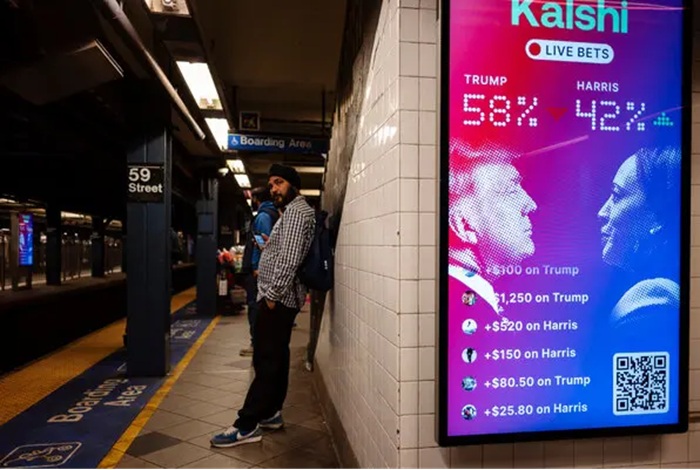
Kalshi is investigating a series of unusually well-timed trades that correctly predicted President Donald Trump’s choice of Katie Zacharia as the next White House press secretary, raising fresh questions about insider trading on political prediction markets.
At least three wagers totaling approximately $173 were placed before major news organizations reported the appointment on October 9. Those positions are expected to generate combined payouts of $9,608, according to The Wall Street Journal, which first reported the investigation.
A Kalshi spokesperson confirmed the inquiry to the newspaper but declined to provide further details. The investigation comes as prediction markets face growing scrutiny over whether people with access to confidential government information can exploit event contracts before the broader public learns what is happening.
Three Bets Predicted a Candidate Trading at Just 1% Odds
The timing and potential returns of the trades have attracted particular attention. Zacharia had been assigned an implied probability of roughly 1% on Kalshi in the days preceding the announcement, indicating that traders overwhelmingly expected someone else to receive the position.
The first identified wager was placed at approximately 10:42 p.m. Eastern Time on Thursday, October 8. The $19 position is expected to return $1,896. Two additional trades, worth approximately $74 and $80, were executed around 1:41 p.m. Friday, shortly before the appointment began appearing in news reports around 2 p.m. Eastern Time. Those positions are expected to return $3,689 and $4,023, respectively.
Combined, the wagers represent approximately $9,435 in potential profit before fees, or more than 55 times the original stakes in gross payouts. The figures are based on the reported trade amounts and projected settlements, rather than confirmed withdrawals.
Trump subsequently announced Zacharia’s appointment through Truth Social. She will replace Karoline Leavitt, who left the White House press secretary position in August. Zacharia previously served in communications roles at the Department of Homeland Security and was a senior communications adviser at Trump Media & Technology Group, the company behind Truth Social.
Although Kalshi publicly displays trading activity without identifying individual customers, it maintains account identity records that can assist internal investigations. The available reporting does not establish whether the three wagers originated from separate individuals or whether anyone involved possessed confidential information. No wrongdoing has been established in connection with these trades.
Previous Insider Trading Cases Increase Pressure on Kalshi
The latest inquiry follows several enforcement actions involving traders who allegedly used privileged knowledge or influenced the outcomes of prediction-market contracts.
On August 28, the Commodity Futures Trading Commission ordered former White House teleprompter operator Gabriel Perez to surrender $107,539.02 in trading profits and pay a $65,000 civil penalty. According to the CFTC’s enforcement order, Perez used advance access to Trump’s prepared speeches between December 2025 and February 2026 to trade contracts linked to words and phrases the president might say. He also received a three-year trading ban.
Separately, former Congressman George Santos agreed to pay approximately $35,000 in penalties and disgorgement in July after the CFTC found that he manipulated contracts concerning his attendance at the State of the Union. Kalshi subsequently imposed its own lifetime trading ban and a fine exceeding $71,000.
These incidents followed an earlier Kalshi insider trading case involving a MrBeast editor, illustrating how advance access to entertainment, political or other event outcomes can create substantial trading advantages.
Kalshi introduced additional safeguards in June, including employment screening for certain higher-risk markets, risk scoring and expanded whistleblower reporting. The company disclosed more than 150 investigations, over 100 potentially improper trades blocked and more than 20 law enforcement referrals during the first quarter.
Congressional scrutiny has intensified as well. House Oversight Committee Chairman James Comer began investigating Kalshi and Polymarket in May. On September 29, the committee expanded its requests to additional prediction-market operators, saying it had already received nearly 1,000 documents and five briefings from Kalshi and Polymarket.
Why a $173 Trade Raises a Much Bigger Market Integrity Question
The important issue is not the modest amount invested. It is the possibility that someone could obtain an enormous advantage in a market where most participants are making genuine forecasts while another participant might already know the answer.
A political appointment is particularly vulnerable to this imbalance. Only a relatively small circle of officials and advisers may know who has been selected before an announcement. A trader connected to that circle would not necessarily need sophisticated forecasting models or substantial capital to profit from the information.
The Zacharia trades demonstrate the financial incentive. A market pricing an outcome at approximately 1% can offer exceptionally large percentage returns if that outcome occurs. However, a low quoted probability is not proof of wrongdoing. Thin liquidity, limited interest in an obscure candidate and ordinary forecasting errors can also produce striking payouts.
That distinction matters. Identifying an unlikely winner through independent research is legitimate forecasting. Misusing protected information obtained through employment or another duty of confidentiality raises a different legal question. Investigators would need evidence connecting the trading to prohibited conduct, not simply the fact that the bets were profitable.
Prediction Markets Face a Difficult Choice Between Growth and Stronger Surveillance
For Kalshi, the immediate challenge is determining whether these trades reflect unusual but legitimate speculation or another instance of information misuse. Employment records, account relationships, funding patterns and trading histories could help clarify what happened, although the findings may not necessarily become public.
The broader concern is whether prediction exchanges can consistently protect ordinary participants. The special risks of mention markets have already attracted regulatory attention because certain outcomes can be known or directly influenced by people connected to the event. Political appointments create similar information advantages, even when traders cannot personally control the final decision.
For retail traders, the risk extends beyond losing an occasional wager. A participant repeatedly trading against better-informed counterparties may face systematically unfavorable prices. Market makers could also become reluctant to provide liquidity in sensitive contracts if they cannot distinguish ordinary speculation from orders driven by confidential information.
That problem connects directly to the economics of prediction markets for retail traders, where information quality, execution speed and liquidity increasingly determine who captures profits and who absorbs losses.
Stronger identity verification, restricted trading lists and surveillance systems could improve confidence, but they would also increase operating costs and potentially reduce the number of markets exchanges are willing to offer.
Kalshi’s investigation is therefore an important test of its enforcement capabilities. A documented explanation showing that the bets were legitimate could help reassure participants. Evidence of misconduct followed by meaningful enforcement would demonstrate that suspicious activity can be detected and addressed.
What would be more damaging is persistent uncertainty. Prediction markets depend on the idea that prices aggregate competing judgments about uncertain events. If traders increasingly believe that some participants are purchasing outcomes they already know, those prices become harder to trust, regardless of how accurately they predict the news.

Johan Shamshad is a financial markets writer at Dave Finances covering cryptocurrencies, trading platforms, brokers, fintech, financial regulation, and developments across global markets. He previously worked at Gulf News, adding newsroom experience to his coverage of fast-moving financial and digital-asset markets.
His work focuses on identifying market-moving events, company developments, regulatory changes, product launches, and shifts in trading and financial infrastructure.
Johan contributes news and analysis designed to help readers understand not only what happened, but why a development matters and how it may affect the wider financial landscape.